
German Auxiliary Forces in WWII
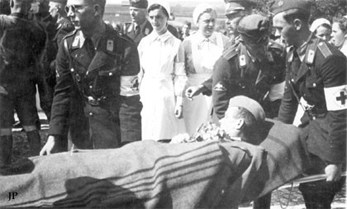
The topic of WWII German auxiliary forces is a complex one. These organizations were by very nature not regular armed forces but auxiliaries to them. In fact, the only true auxiliary forces were the Wehrmachtsgefolge, or armed forces auxiliaries, which were those formations or organizations that were not a part of the armed forces, but which served such an important support role that they were given protection under the Geneva Convention and/or militarized.
The armed forces auxiliaries consisted in part of the Reichsarbeitsdienst, NSKK, Organization Todt, and the Deutscher Volksturm. Although some of the armed forces auxiliaries were militarized, it was specifically decreed that they not achieve armed forces status on par with the likes of the Heer, Luftwaffe, or Kriegsmarine. Wehrmachtsgefolge provided all manner of support to the Wehrmacht in the form of added transportation, construction help, garrison and security work, combat engineering, railway repair, anti-aircraft defense, air-raid protection, and early warning services, and in the end, even frontline combat duty.
The other forms of auxiliary formations, although not specifically known as Wehrmachtsgefolge, such as the Hitler Jugend, Kraft durch Freude, Deutsche Reichsbahn, and Deutsche Rote Kreuz, also provided invaluable support to the Wehrmacht. Those listed here at left are by no means all such organizations that existed during WWII, but they are those that most directly supported the Wehrmacht or the war in general during and prior to WWII.
Many of the auxiliary organizations were thrown into the last-ditch attempt at preventing total defeat as WWII came to a close, many members being used in direct combat roles as the fronts collapsed. In the end, all formations, armed forces auxiliaries or not, were disbanded and declared illegal with the fall of the Third Reich.
Main Topics
Air Organizations
- N.S.Fliegerkorps+
ARP* Organizations
Defense Organizations
- Deutscher Volksturm+
- Deutscher Werewolf
Labor Organizations
- Deutsche Arbeitsfront
- Kraft durch Freude
- Organization Todt+
- Reichsarbeitdienst+
Motor Organizations
- N.S.Kraftfahrkorps+
State Organizations
Welfare Organizations
- Deutsche Rote Kreuz
- NS-Volkswohlfahrt
Youth Organizations
- Bund Deutsche Mädel
- Hitler Jugend
- Napolas
- NSDStB
+ = Wehrmachtsgefolge
* = Air Raid Protection
RESEARCH THEMES
OUR RESEARCH THEMES
Select ThemeReichswehrThe German Imperial Army 1918 – 1935
anchourReichsmarineThe German Navy 1919-1935
anchourHeerThe Nazi German Army 1935-1945
anchourLuftwaffeThe Nazi German Air Force 1935-1945
anchourKriegsmarineThe Nazi German Navy 1935-1945
anchourWaffen-SSThe Nazi German Armed Waffen-SS 1933-1945
anchourWehrmachtsgefolgeAuxiliary Organizations
anchourFreiwilligeForeign Volunteers
anchourAlliierteAxis Powers
anchourKollaborationAxis Collaboration
anchour