
The Nazi German Armed SS 1933-1945 (Schutzstaffel)
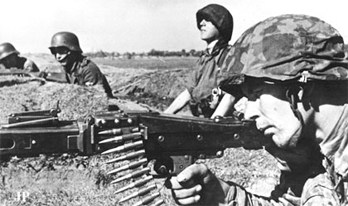
Of all the German military organizations of WWII, the Waffen-SS is one of the most widely studied. This is in part because of the combat record and the elite status of many of its units, and in part because of the brutality attributed to some of its formations and the war crimes some of its members were responsible for. By the end of WWII, over 1,000,000 soldiers in 38 divisions would serve in the Waffen-SS, including over 200,000 conscripts.
The Waffen-SS was a part of the German Schutzstaffel or German SS, which saw its rise during the late 1920s and early 1930s. The German SS was the single most powerful political organization within the Third Reich and consisted of the Allgemeine-SS, Totenkopfverbande, and the Waffen-SS.
The Waffen-SS was born in 1933 after Hitler came to power when Politisches Bereitschaften or Political Readiness Detachments were formed under the control of the German SS. These units were organized along military lines and were intended to help counter Communist strikes. On October 1st, 1934 these units became the SS-Verfügungstruppen or SS Special Use Troops. Initially, the Verfügungstruppen consisted of small detachments located in larger German cities but by 1935 they were organized into battalions and in 1936 into Standarten or regiments. In 1936 two main SS-V Standarten existed, Deutschland and Germania. The Leibstandarte SS Adolf Hitler also existed at this time and although related it was considered somewhat outside the purview of the SS-V.
In 1938 the SS-Verfügungstruppen took part in the occupation of Austria and Czechoslovakia alongside the Wehrmacht. After the occupation of Austria, a third Standart was formed known as Der Führer. In 1939 the SS-Verfügungstruppen consisted of three Standarden, the LAH, and a number of smaller service and support units. For the Campaign in Poland in 1939, all SS-V units were organized into the SS-Verfügungstruppe-Division and placed under the operational command of the Wehrmacht. The SS-Verfügungstruppe-Division also fought in the Western Campaign 1940. After the conclusion of the Western Campaign, the SS-Verfügungstruppen was renamed and became the Waffen-SS.
Although the Waffen-SS is frequently considered an elite organization not all of its units were actually elite. Some units formed after 1943 had less than ideal combat records. This was in part due to the fact that the number of volunteers eligible for service in the Waffen-SS shrank as the war continued while the need for replacements increased. The number of conscripts taken into the Waffen-SS of lesser quality or questionable ability had a direct impact on combat effectiveness.
After WWII ended the Waffen-SS was rightly condemned at the Nurnberg Trials as a criminal organization. This was because of numerous high-profile atrocities and their connection to the German SS and NSDAP. As a result, veterans were generally denied the rights and benefits granted to other WWII German veterans. Only those who were conscripted were exempt from the Nurnberg declaration. Waffen-SS prisoners of war were often held in strict confinement and were treated harshly by the Soviets. Many foreign volunteers that served were also treated severely by their national governments. In the years since WWII, there have been attempts to rehabilitate the image and legality of veterans, both through legislation and in published works by apologists like Paul Hausser (Soldaten wie andere auch – Soldiers Like Any Other). These efforts have largely failed and to this day the stigma on veterans remains.
The basis for Feldgrau lays within our unit histories. In this section, you will find all units documented to one degree or another. The many gaps in these listings will be filled during the coming months and years as additional research aids in completing this monumental reference tool.
Complete Unit Histories
- 1934-1940 SS-Verfügungstruppe unit histories
- 1940-1945 Waffen-SS Order of Battle
Quick Access Unit Histories
- Waffen-SS Divisions
- SS-Infanterie-Divisionen
- SS-Gebirgs-Divisionen
- SS-Panzer-Divisionen
- SS-Schnelle-Truppen
Other sources for unit history information
Before embarking on any study of German unit histories it’s helpful to have access to research material regarding ranks, formations, terms, and other related concepts.
- Glossary of German Military Terms
- WW2 Germany Statistics, Numbers, and Losses
- WW2 German Indentification Documents and Tags
- Weapons and equipment
If you have a question about a concept or something specific, you can post a message in our German Armed Forces Forum.
RESEARCH THEMES
OUR RESEARCH THEMES
Select ThemeReichswehrThe German Imperial Army 1918 – 1935
anchourReichsmarineThe German Navy 1919-1935
anchourHeerThe Nazi German Army 1935-1945
anchourLuftwaffeThe Nazi German Air Force 1935-1945
anchourKriegsmarineThe Nazi German Navy 1935-1945
anchourWaffen-SSThe Nazi German Armed Waffen-SS 1933-1945
anchourWehrmachtsgefolgeAuxiliary Organizations
anchourFreiwilligeForeign Volunteers
anchourAlliierteAxis Powers
anchourKollaborationAxis Collaboration
anchour